Finding a Safe Haven
The hunting pressure on Canada Geese this time of year is almost constant in our semi-rural area. The guns go off almost without ceasing. A few minutes after a round of shotguns go off, you'll see a flock of survivors fly over looking for a safe field in which to land. Places that are both safe and also contain food are relatively hard to find.

There is a large pasture on the edge of the Bay where the geese have learned they are safe and where I have learned you can find them pretty reliably. There is also a small marshy area on the other side of the road where these photos were taken. I am standing at the road. (If you want to take pictures on someones property, ask the owner's permission. Don't just assume it is okay.) The brushy area at the back of the photo is the shoreline of the Bay, so you can see that it is a fairly narrow area. If I hadn't told you that, though, it could pass for the edge of marsh in a wilderness area. In any event, with the long lens, I don't need to get any closer or ask permission.

This is a naturally occurring puddle which must stay wet much of the year based on the grasses growing in the surrounding area. Geese are highly attuned to what goes on around them. If you see a flock on the ground eating, you will always see at least one that is simply keeping guard. No one is appointed; it is simply a rule that if your head is up, you are watching for danger. So, forget sneaking up on them. You are not going to be able to do that.
The approach I use (no pun intended) is to move slowly. It is best to move at a tangent and not directly toward them. If they become suspicious of you, they will begin to waddle away. If they become alarmed, they will fly. If you stand still for a while, they will settle back down. After that, as long as you don't do a lot of moving around or make any loud noises, they will go back to doing what geese do. You can tell from the two standing that the water is not very deep.
About a year ago I posted pictures of Canada Geese completely upside down taking a bath with their feet sticking up in the air. The geese here are using the more traditional method of bathing by ducking their heads under and throwing the water over their back.
Here is another closer look. When my wife and I were doing a lot of fishing, we had a boat. I always thought it was better to go to the fish instead of hoping the fish would come to you. Duck and goose hunters, on the other hand, have to hope the waterfowl will come to them. Seems to me you better know how to pick a good spot.
Doo, Doo, Doo, Looking Out My Backdoor VII: Mourning Dove
Not a bird you would normally associate with a bird feeder, but we've almost always had doves around the feeder. Not too many songbirds will eat kernel corn or cracked corn, so if there is any in the mix, it usually will end up on the ground under the feeder. And that is what attracts the doves. They are such sweet birds, recalling Jesus statement in Matthew about being as "innocent as doves." So, here you have the picture of innocence. Doesn't it look like it is asking, "Who me?"
We had a feeder at another home we had and, at the time, the seed mix we used had quite a bit of cracked corn in it. One winter, that started attracting doves. The flock kept building over time and I kept counting them from one day to the next. Twenty one day. Twenty-four a few days later. The last count I took was 53 sitting in the mulberry tree where the feeder hung. Fortunately, once they settle down on a branch, they tend to stay there for a while and not flit around like smaller birds. So, I'm pretty sure the count was accurate.
I always think of a painting when I see a picture of a dove. Look at the rounded feathers and the darker spots of color. Each feather is separate and carefully delineated.
Doves have very short legs which causes them to bob their heads when they walk. Doves are found throughout almost the entire continent and are also considered a game bird, although I don't know how anyone could shoot them. It seems to me you couldn't harvest enough meat off one bird to make cleaning it worth while. But then, maybe they are sooo
good that it is worth the effort. I don't know. I've never tasted one.
These last two photos were taken with my "junk" telephoto and are not as sharp as the others. This photo may look as though it was taken in deep woods, but it was actually taken through the kitchen window after a pine tree fell on the deck. I left the tree there for a couple of months (it didn't do any damage and it was winter) so that I could use it as a background. There wasn't any snow, but it was a cold winter day so the dove was fluffed up.

Doves are thought to be monogamous through more than one breeding season. I am pretty sure these same two doves that were long-term visitors to our house were mated through at least four or five years. You can see a slight difference in coloration although I would not hazard a guess as to which is male and which is female. Well, okay. The one on the left is a male. That's my guess. I shot this out the second floor bathroom window and they were off to the side which caused me to have to tilt the camera and that is why the trees are not straight up and down. But, there are times when this gives a photo a more dynamic feel.
Doo, Doo, Doo, Looking Out My Backdoor VI: House Finch
This is a fine example of a male House Finch. The species is not native to America, but was introduced into New England in the 1940's. They have now spread over pretty much the entire country. There is a reason they are called a House Finch. They like to build their nests around human habitations taking advantage of being able to build under eaves and keeping their nests dry. The shadow passing over the bird's breast would pretty much exclude it from use in a bird magazine or book.
This female had gathered nesting material and was waiting for me to leave the porch so she could come in a add it to her nest in a hanging basket. There is not the slightest bit of red in her feathers to link her to the male.
Here is the hanging basket in which she built her nest. It did not bother her in the least that the plants were all fake. She laid
a second batch of eggs within a week of fledgling the first brood! While they are prolific, it is probably due to a low survival rate.
I didn't understand it, but this female had two males that were bringing in food for the babies. I could tell them apart because the second male was thinner and had a peak on the top of it's head. That, and the fact that this one would try to chase him away. It is the only case avian polygamy I have personally ever seen.
Doo, Doo, Doo, Looking Out My Backdoor V: Eastern Towhee
Until recently, this bird was known as the Rufous
-sided Towhee, but the race was split in two, more or less divided by the Mississippi River. The race west of the Mississippi is known as the Spotted Towhee. Females are almost as dapper as this male, except where he is black, she is brown. Notice the ruby red eye which is not always visible unless the light hits it right. Towhees are about the size of a robin.
We almost always have a pair around our house, although this past summer we had a male with no mate. I believe they mate for life. They are fairly secretive birds and it is rare to see them when I am outside. They only seem to come around when I am inside and can view them through a window. When you do see them, they are almost always on or near the ground. They like to kick up leaves in search of insects. They are high on the list of my favorite songbirds.
Doo, Doo, Doo, Looking Out My Backdoor IV: White-breasted Nuthatch
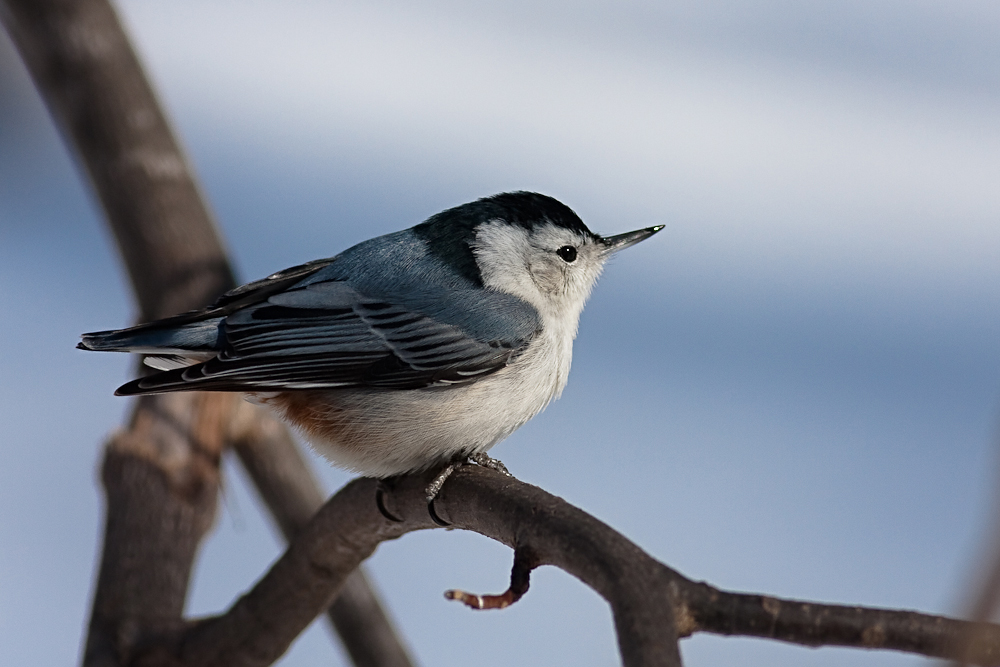
Nuthatch is derived from a European word, "hatch," probably meaning to "hack" open a nut. This photo is a good photo for seeing it's identifying features. Males and females are exactly the same except that the male's
color is more intense. The best way to tell them apart is to see them together. My experience has been that they mate for life although the books say it mates for a season. You almost never see one without the other, however. Notice the slightly upturned lower bill which is not seen on many other birds.
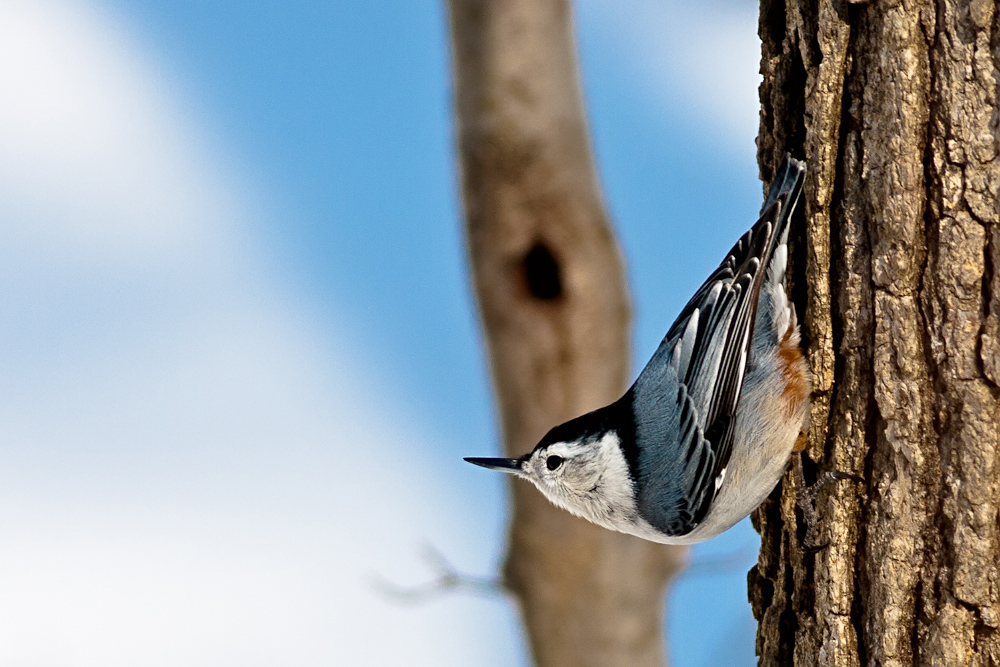
If you see a bird on the trunk of a tree traveling down rather than up the tree, it is almost certainly a nuthatch. They are almost the only bird that can do this. Notice how, if the bird in this photo were resting on a horizontal surface, it's head would be looking straight up in the air. This "L-shaped" stance comes very naturally to a nuthatch. A look at their skeleton would probably reveal quite a difference between their spine and that of most other birds - but, I'm just speculating.

In this photo you can see the advantage of the very long backward facing toe by which they are able to hang in a downward direction. It is thought that because they are able to descend on a tree trunk, they are able to find insects that escape the notice of woodpeckers and creepers that travel in the other direction. The snow in this photo adds a lovely blue background. Snow, especially in shaded areas, is actually very blue, but our minds translate the color because we know snow is white. As a photographer, you almost have to force yourself to examine the "real" color that is present.

Here is something many birds do occasionally, but the nuthatches that come to the feeder do quite a bit. They "puff" themselves up in an attempt to make themselves look larger and, therefore, more intimidating in an attempt to scare other birds from the feeder. They are actually quite shy and don't like to be on the feeder with other birds. They will puff themselves up like this and rock back and forth, looking to see if it worked. It is amusing to watch.
Cobs and Pens
Can you tell which ones are pairs? Seems pretty obvious, doesn't it? Males are called "cobs" and females are called "pens." I don't make this stuff up. My guess is that males are called cobs because they are so rough while females are called pens because they are so domestic. You're welcome to your own opinion.
The majority of the time, the swans were very quiet and most were feeding. Like geese, anyone not eating was standing lookout. But then, every once in a while one would get to honking and it would be joined by what appeared to be it's mate. This would become an encouragement to others and they would all join in the "celebration" as they swam to meet each other.
While it made for great pictures, what motivated the "meet-ups" or what purpose they served was not completely clear. In some photos the action might be interpreted as being mating ritual, but I wouldn't swear to it. I would expect that ritual would be a little more involved than what I was seeing.
The migration back to the north will probably take place around the end of February to the middle of March. The actual nesting season in the high arctic is from about May through September. In that time they have to recover their strength from migrating, build a nest, lay the eggs, hatch the young (which takes 2 to 2-1/2 months), and raise them to the point where they can migrate with the parents. That is a pretty compressed schedule!
Once in a while I realize what a privilege it is to peek into the lives of these wondrous creatures and share them with you. I am glad I can share some of the experience with you, the reader.
White Wings
Compare these photos to those posted in the first Tundra Swan entry taken in bright sunlight. While, in some, there was a little bit too much fog, for the most part I prefer the softness of these images. Can you believe these are the smallest of the swans?!
Swans migrate to the same traditional places year after year and stop over in the same locations along the migration route. This allows them to teach their young the route. Young from previous years will often meet up with the parents and form "super families," allowing them to dominate the best feeding areas.
Is this not the picture of grace? They have been known to fly at an altitude of 28,000 feet, almost 5-1/2 miles up! And they don't hold the record. Some birds fly even higher, notably those that cross the Himalayan mountain range. You wouldn't want to run into one of those with a jet.
Swans fly in v-formations or in a slightly offset straight line when in smaller numbers. Oh, to have a longer lens. But, I would have to mortgage my house to get one. No kidding. You wouldn't believe how expensive a fast 500 mm lens f/4.0 is - $10.5K!
I only saw four birds fly that day. Take-offs and landings are at the top of my list. Only thing is, if they are content with where they are, it can be hours before they think about flying. For their own safety at night, they may spend the night well out in the Bay away from predators, so they may fly toward evening. I can only hope that a few will want to cross to the other side of the pond during the day and will fly instead of swim. That is what these swans were doing.
Tundra Swans were formerly known as Whistling Swans. Whistling apparently refers to their voice rather than the sound of their wings in flight. Their voice, however, could not be described as a whistle by any stretch of the imagination. A flute-like sound with the volume of a French horn, maybe. I wish you could hear how musical they sound.