Monday, March 9, 2015

They're not all at Walmart


It has been a rough winter for all birds — including the ubiquitous seagull. Some gulls migrate to warmer climes while others simply migrate to the nearest Walmart parking lot. For some, this area may have been the warmer clime — which was a big mistake this year. This photo only takes in about a third of the flock that was just standing around on a local frozen pond.


At the top of the far shore in the first photo is a rail line for CSX trains. On the other side of the railroad tracks is another smaller pond. The ponds are within a few hundred yards of a busy road intersection, so when a train comes through, they sound a long warning. I was at the pond one day recently when a train approached and blew it's horn. There weren't any seagulls in the pond I was standing at but, to my surprise, a couple thousand bolted into the air from the pond on the other side of the tracks. This was just a small portion of them.

More gulls standing around on ice waiting for the thaw.


Mass take-offs of flocks are chaotic, but I'll go ahead and film them occasionally on the chance that, with a little cropping, some sense can be made out of image. The lighting was bright and not terribly harsh, so I had predetermined to film the gulls on the pond if they took off.


Ice and snow will fool the metering system of a camera and a "normal" setting will be rendered underexposed, causing snow to appear to be gray or blue rather than white. To counter this, I set the camera to over expose one full stop so whites appear white. Care is needed, though, because it is easy to blow out the whites so that those areas become featureless. Gulls can be pretty mundane subjects, but with good lighting, these Ring-billed Gulls with their varied expressions result in an interesting image.


Sometimes you can use color to create even more interest in a photograph. I decreased the color temperature in the original file (you cannot do this with a typical jpg file) so that the ice appears bluer than it actually was. This causes the frozen wavelets to become more noticeable so that a rather ordinary photo of a gull landing becomes interesting throughout the entire image.

Sunday, March 8, 2015

Better Days are Coming

I don't know how animals survive and thrive in winters like we have just been through. Suffering from a bad case of cabin fever yesterday, my wife and I visited a local pond. While there were a few small openings in the surface, most of it was still slushy ice, making it difficult for the birds that were there.

I'm not sure where puddle ducks, such as these Mallards, go when ponds freeze over. I can tell you where they don't go since I have gone on a lot of outings this winter that came up empty.


Better days are coming. By the end of this week, I'll probably be breaking out the lawn mower...


Saturday, March 7, 2015

Waterfowl in Flight III


This beautiful duck, the Northern Shoveler, is another of the family of puddle ducks that feed from the surface of the water. Look at the handsome colors and intricate feather pattern on the back of this male!


This is one of a number of species that tip up and feed from the bottom of shallow areas in ponds and marshes. A shovel-shaped bill that exceeds the length of the head is one of it's most prominent characteristics.


These males are in breeding colors which differ quite a bit from their drab appearance when they sport their non-breeding plumage.


Other than two of the teals, this is the only duck that has blue on the forward part of it's wing.


Typical of almost all female duck species, the Shoveler female has much more subdued coloring. Unlike other families of ducks, puddle ducks can spring into the air without a running take-off.

Friday, March 6, 2015

Waterfowl in Flight II


Okay, so he's barely flying. Like I said yesterday, they are fast! Still, it shows the beautiful pale colors of the Northern Pintail. Have you ever seen a duck with white feet? If you look at the central tail feather, you'll see how they got their name. This is a male.


The chocolate-colored head and gray bill are good field markers as is the general overall slender appearance.


The family of ducks to which the Pintail belongs are called dabbling ducks and forage by straining food through their bill. You can often see them tipped up like Mallards, which are members of the same family.


Those funny looking 'islands' in the background are actually the rhizomes of lily pads and, to have gotten so large, they have to have been there for years. The water in this area is probably almost shallow enough to stand in.


The thin line of white feathers on the back of the neck is yet another good field marker. Despite the lack of bold colors, this is a beautiful duck species. And, despite it only being February, you can see the tips of lily pad leaves ready to emerge when the weather turns warmer.

Thursday, March 5, 2015

Waterfowl in Flight

One of things on my photographic bucket list this winter was to film duck species I have not seen before. A secondary goal was to try to film them in flight. If you have ever watched ducks fly, you know that they can fly extremely fast. That can make it a challenge to obtain images before they get out of range.


An additional challenge is presented by the direction they are flying when they pass you. Shots of almost any bird flying directly at you are not very pleasing. The bird appears to be a series of circles with the body looking like a circle, then the head, then the bill. Shots head on can be pretty ugly and maybe I'll post some examples in a future post.


Birds flying away from you are not very good either - although there may be some value in seeing the pattern of the upper side of a bird in flight. That can be helpful in identification.


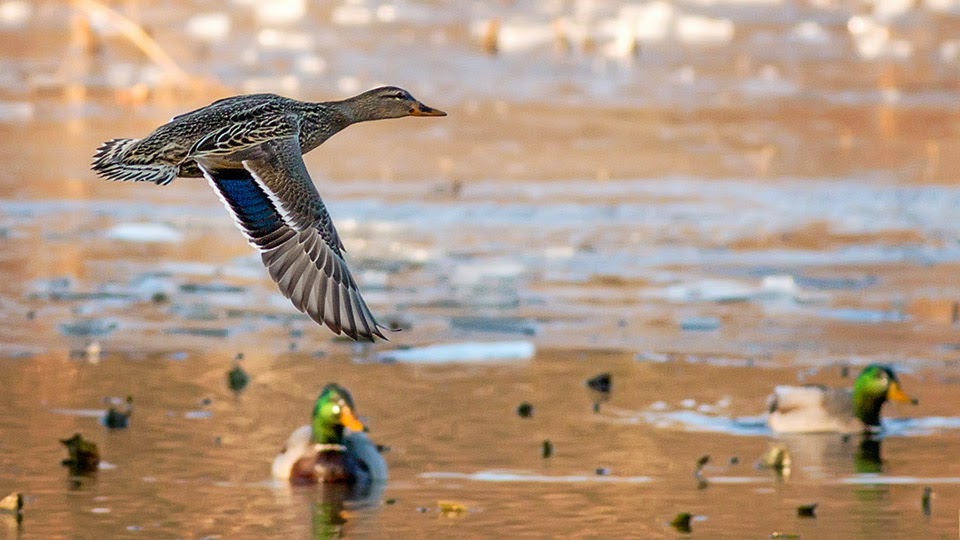
The best shots are when a bird flies past your location presenting a side view. This is a female Mallard. The blue area on the wing is called a 'speculum' and you will notice it is bordered by white on each side. Although many female species have a similar mottled color, the wing pattern as well as the dark area on an orange bill, denote this as a female Mallard.

Color can sometimes fool you. Notice how the speculum appears a rich, deep blue on the first three photos, but teal in the last. The direction of the light striking the bird can really change the appearance of a bird's color.


Wednesday, March 4, 2015

Tundra Swans

It has been a difficult winter in many ways. Waterfowl hunters over the entire region complained about the lack of birds in the early winter. I don't hunt, but I kept tabs on what they were seeing and where to, hopefully, up my success at finding birds.

One species I hoped to film again this winter was the Tundra Swan. I had hoped to be able to film them in flight since they can be a very graceful looking species. As it turned out, I was always only able to see them from a distance and had almost no opportunities to film them.

These two images taken at a local marsh pond were taken too far away and at the wrong time of day. The sun was out in front of the camera, causing the side facing the camera to be in shadows not to mention a lot of sparkly, bright water. By adjusting color temperature of the image, they can be rendered as either cool or warm. The photos may not be to everyone's taste. 


Tuesday, March 3, 2015

Oh, Canada!

One of the few waterfowl that have been easy to find over this winter has been the Canada Goose. Whether they have been resident geese or visitors from Canada is another question. There must be some way of telling the difference between the two because Maryland  hunting laws make a distinction. Since I don't hunt, I am not aware of how to tell the two populations apart.

For a few days, I am going to simply post photos I have taken recently. I liked the ordered confusion in the first two images with geese taking off in different directions. That is something you don't normally see. They will normally all take off in the same direction.


The background in these last two photos may look "wild," but within sight of these geese is the Administration Building for one of the largest counties in the Washington area. One of the photos is a little "better" than the other because all of the heads of the geese can be seen.