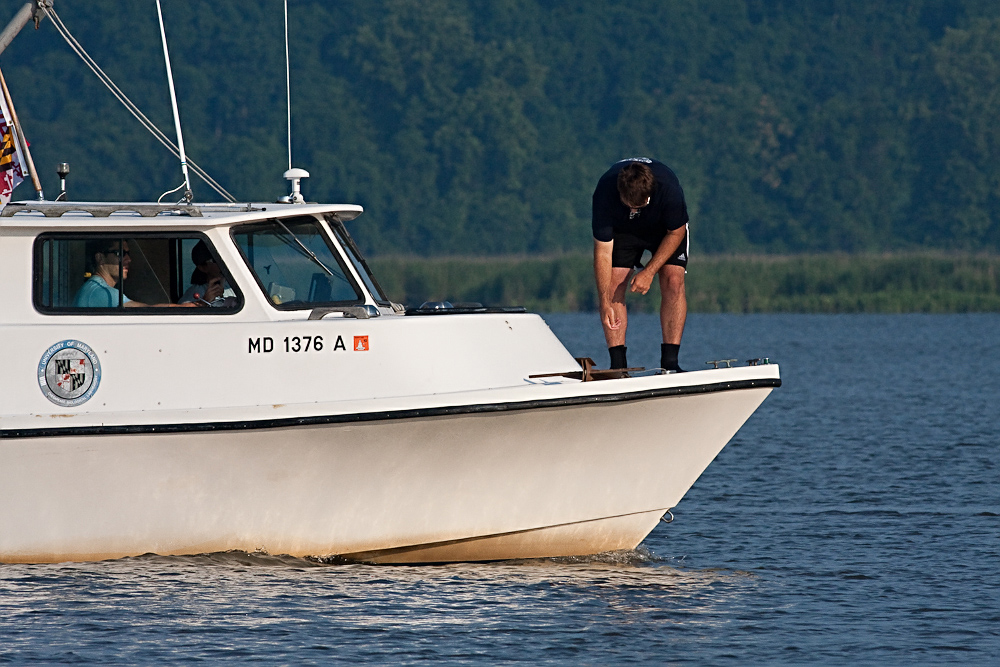
The health of the Chesapeake Bay should be a concern to all of us who live in the region. The job of trying to quantitate the complex results pollution has on the biomass of organisms that form the food chain - from the smallest microbes at the bottom to the largest, most visible members at the top - falls to several government and quasi-government agencies.
The Chesapeake Biological Laboratory, one of these entities, is part of the University of Maryland. Their facilities are located on Solomons Island, where the Patuxent River empties into the Bay. They develop approaches to trying to solve environmental problems. Their research is supported by several federal and state agencies.
During the summer, this team of individuals from CBL
are tasked with taking samples and readings from the Patuxent
at several sites in an ongoing study of the river. I had a chance to talk with them when they stopped to take samples along the shore where I was filming a couple of times.
One of the tasks they perform is to drag a one hundred foot seine net along the shoreline. One of them gets to tiptoe into the river up to his ears and drag the net downstream, finally closing the net and bringing his end in to the guy holding the other end on shore. The dry guy.
I remember on the second occasion that I was there the same time they were, the tide was really ripping. At one point, Chris, the guy in the water, said he thought he was going to get carried away. That is not to mention the day before I had seen the biggest snapping turtle I have ever seen swimming in the same general area. Some of the hazards of the job.
The net isn't light and you have to be in pretty good shape to drag it in once it has been deployed.
While the two guys are seining, the third member is collecting water samples and measuring things like pH, salinity, turbidity, etc.
Much of their catch consists of fry of the year - shad and rockfish
. The shad are a major food source for some of the larger fish species as well as bird species such as Eagle, Osprey and Great Blue Heron. That being true, you can see how the health of the shad population is closely tied to the health of fishery - those species targeted by both the recreational fishermen and commercial fisheries. Sadly, the shad population is in big trouble which reverberates up the food chain. That same food chain relationship, though, exists from the smallest microscopic plankton (for example) all the way up the line. And the common denominator is the water in which they (try to) live.
After completing their sampling, it is time to haul anchor and move on to the next site.
I can't help but think of Luke 16:10 which says, "He who is faithful in a very little is faithful also in much..." It is tempting to say, "There is nothing I can do about the water quality of the Bay and, besides, it is not my problem." I would say that if each of us will take responsibility for our every day actions - something as simple as not flushing old prescription medications down the toilet - the sum total of all those small actions would have a big effect on the Bay's water quality and, ultimately, our lives.
In the post on April 18, 2013, entitled "Screen Savers," I wrote: "Corel
Painter (a wonderful software program for the more artistic amongst us) has a kaleidoscope plug-in. It is the only program I know that has one. You tell it how large an area in pixels you want to make it and then place it over a photograph and move it around until you see something you really like and then hit enter to close the deal. It is such a fascinating plug-in. It is downright addictive and I have to stay away from it because I could easily spend hours fooling with it. I'll have to make an example that I can show in a future post so you can see what I am talking about. It is just very, very cool."
I took the above image of a geranium into Corel
Painter to illustrate this kaleidoscopic effect for you. Below are five examples of simply randomly moving this "tool" over different areas of the opening image.
It may actually be an improvement over a analog kaleidoscope in that you can change images and get an entirely different color set and shapes whereas with a true kaleidoscope you are limited to the pieces that are in the end and things can begin to look the same after awhile.
Sometimes parts are identifiable and other times they are just completely weird. In another part of the program, you can create patterns based on the results.
I could have produced a thousand of these things out of this one image and none of them would look exactly like another. Like I said, it can be addictive.
Images with a lot of detail and strong colors produce better looking results. I wouldn't buy the program just for this one tool, but it certainly adds some fun to the program.
Among my favorite birds, the Carolina Wren is a small, active songbird that is well adapted to human presence. They are like the chipmunks of the bird world, having a similar lovely brown coloring with racing stripes and having a resemblance in their quick movements. I am always amazed that such a loud voice comes out of such a small bird. Ounce for ounce, they probably have a louder voice than almost any other bird.
Assuming it was hung there for them, a pair of wrens started building a nest in a basket of geraniums on the porch the same day it was placed there. They wasted no time and didn't care who was sitting close by as they had a substantial nest built by day's end.
There is no difference between the look of the sexes, and both will participate in nest construction. The male will often build the base while the female will line the nest with finer materials and feathers. So my guess is that most, if not all, of these photos are the male.
Wrens are interesting because they will construct nests for more than breeding. They will sometimes make a nest simply for roosting in at night. In fact, for several years, we have had a pair that roost in a hanging basket on our porch over the winter. I took an empty hanging basket and filled it half-way with sand, then took one of those throw-away plastic containers that lunch meat comes in and put that in the basket upside down after cutting a "door" in the end. I lined the inside with moss and put leaves over the top and it wasn't long before the wrens found it. They readily accepted it and have roosted there on cold winter nights ever since.
They are funny because they will arrive well before dark. They will fuss a little bit if one of us happens to be out there, but that won't stop them from going to roost. Usually there are two, but I have seen three go in there where they can keep each other warm. The nice thing about this location is it is in a corner of the porch which gets little wind and it is at the back of the porch, so it never gets rained or snowed on. They did a little rearranging, but basically they accepted it as is.
I love the short cocked tail on a wren. It seems in tune with their attitude. If I could describe them in one word, I was use the word joyful. Everything about them seems happy.
They often keep in touch with their mate (they are monogamous) by singing, and the mate will answer with a different call. One year, the parents brought their brood of three up on the porch after they fledged. I think they were going to settle in for the night on a wreath hanging on our side door. I didn't see them sitting on the wreath and happened to open the door. Two were fast enough to fly off immediately, but the third hesitated just long enough that when it flew it was facing the interior hallway and flew into the kitchen. It took us a while to capture it and return it to the outdoors.
It wasn't quite fall yet as you can see from the trees in the background, but because of the yellow leaves, it has a feel of fall. This is a female goldfinch, whose colors are more muted than a male. By not centering the bird, it allows your eye to roam around the picture and return to the goldfinch. Diagonal lines in a photo give a picture a more dynamic feel, but some thought needs to be given to where the diagnonal - in this case, the branch - enters the frame. Also, all things being equal, if the bird had it's back to the camera, it would not have been a successful picture. Sometimes, a bird facing directly toward the camera will look odd because the beak will become much less prominent, so that needs to be kept in mind also.
Among the flowering plants that perennially appear in the little "meadow" in my side yard each spring is this flower in the fleabane
family. It is a type of wild aster called "Robin's Plantain" and stands about 1-1/2 - 2 feet high. It is found over the entire eastern half of the United States and Canada. There is nothing in the photo to which to compare it's size, but the blossom is a little larger than a nickel and a little smaller than a quarter.
Here is the blossom of one flower which illustrates how a macro lens can film things at life size or even larger. As you film closer and closer, however, depth of field becomes a real problem. Notice how the top half of the bloom is not in focus. Focusing was further complicated by the wind on the day I took these pictures. Also, notice how the petals have a slight pinkish hue which is more noticeable when they have newly opened. On some Robin's Plantain, the hue can be slightly bluish.
One year a type of weevil took an interest in the blooms. There are over 60,000 different types of weevils. The boll weevil is probably the most well known of them all. If the flower is a little smaller than a quarter, you get the idea of how small these weevils were. They were only five or six millimeters in length.
Trying to get the best compromise between shutter speed (a slow 1/40 sec.) and focus (f/13) produced this photo where not quite everything was in focus. Plus, now the dust on the sensor became visible (the little black spots which can be cloned out, but is a pain if there are very many of them).
I thought they would make a good subject for macro photography. I used a 100 mm macro lens as well as an extension tube (which allows even closer focus) on a focusing rack. The rack allows movement of the entire camera rather than only the lens. In other words, I could focus fairly close, then adjust the rack to "fine tune" the adjustment.
What I didn't count on was the wind that day. One second the flower would be in the frame and I would try to carefully focus and the next second the wind would blow it completely out of the frame. There are different solutions to wind such as take it indoors or block the wind with something like an umbrella, but perhaps the easiest is just to come back on a day when it isn't windy.
Can you believe the Latin name? I can. For some reason the Robin I posted a few days ago has taken to perching on the tops of our cars and you know what happens when a bird takes off...
Actually "Turdus
" means thrush and it is in the same family as the Wood Thrush that was building it's nest in the same tree. This was a year or two ago, however. It is even the same branch, only up against the trunk.
Robins will often use grasses to build their nest, but since leaves were more available to this bird, her nest was constructed almost entirely of leaves.
Her nest was very similar to the Wood Thrush and she took the same care with tamping a bowl shape into the nest using her breast.
I was using her nest building technique as a template for the Wood Thrush. Towards the end of construction, she started bringing in mud to line the nest with and stiffen it up. I thought the Wood Thrush would do the same thing, but it turned out she didn't use any mud at all.
The final step was to also, like the Wood Thrush, bring it rootlets to line the cup. Her nest wasn't successful either and I am pretty sure it was also a squirrel that destroyed it. I don't think they are intentionally being destructive. I think they just get curious or are looking for food and knock the nests out of the tree. I have seen squirrels actually pulling chunks of bark off this River Birch. It comes off fairly easily, but I have no idea why they were doing it. They weren't eating anything. Just being squirrels, I guess.
You may be able to identify a bird even if you do not have any bird books. The internet
is a wealth of information on just about any bird you could see. What are some of the details you should note when you see a bird you don't recognize? Two of the biggest, of course, are it's size and color. Behavior may also be a clue. Was it catching bugs on the ground or was it high up in a tree? Was it kicking leaves on the floor of the woods or was it flicking it's tail nervously? Behavior can be a big clue.
With this little bird, some of the clues came from it's behavior and some from details on it's body. The photos were taken in October when many birds are migrating and it was sitting in a dogwood tree which had ripe berries on it. (In fact, robins stripped the tree within a couple of days of hundreds of berries.)
My initial thought was that it was a species of warbler because of it's small size and bill shape (more clues). If you can make some quick notes before you forget, you can note details about different parts of the bird. For example on this bird, I noticed the eye ring, the lack of eye stripe and the streaked (versus unstreaked) breast.
Other views of the bird gave me yet more clues. The yellow rump was a big one and the marginated
primary and secondary feathers on the wings were others. All of your clues will help you exclude some species and narrow your search.
It is barely noticeable in the first two photos, but there is a patch of yellow in the shoulder area which can be seen better in this image. White patches on the underside of the tail are also seen here, but in no other image. One last detail to consider is a bird's normal range. While birds are found in areas in which they are not normally seen, it is much more likely that if a bird is not normally found in your area, you have the wrong bird.
With the information I had noted about this particular bird, I determined that it is an immature Yellow-rumped Warbler, a bird found throughout North America that is able to winter further north than almost any other warbler because it can survive by eating berries when insects are unavailable.